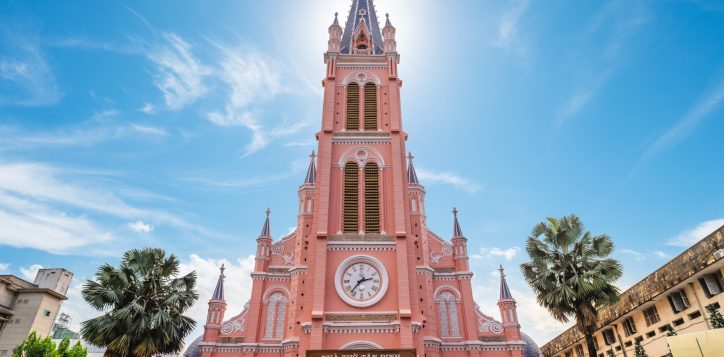
Exploring Tan Dinh Church – Saigon’s Pink Church with More Than 150 Years of History

Novotel Saigon Centre
Languages

- English
- Tiếng Việt
- 简体中文
- See this hotel on all.accor.com or brand website in other languages :
Exploring Tan Dinh Church – Saigon’s Pink Church with More Than 150 Years of History
Amid the busy streets of central Ho Chi Minh City, Tan Dinh Church stands out with its distinctive pink façade and a history spanning more than a century. Located on Hai Ba Trung Street, the church continues to serve the local Catholic community while also attracting visitors interested in architecture and the historic character of old Saigon.
What makes Tan Dinh Church notable goes beyond its exterior colour. Behind its recognisable façade is a building that was developed and expanded over several periods, combining Romanesque architecture with Gothic and Renaissance elements. For visitors planning a trip, understanding its history, architectural features, Mass schedule and practical visitor considerations can help make the experience more convenient.
| Information | Details |
| Name | Tan Dinh Church |
| Parish dedication | Sacred Heart of Jesus |
| Address | 289 Hai Ba Trung, Xuan Hoa Ward, Ho Chi Minh City |
| Inaugurated | December 1876 |
| Distinctive feature | Pink façade |
| Weekday Mass times | 5:00 AM, 6:15 AM, 5:30 PM, 7:00 PM |
| Sunday Mass times | 5:00 AM, 6:15 AM, 7:30 AM, 9:00 AM, 4:00 PM, 5:30 PM, 7:00 PM |
The address and Mass times above are currently published by Tan Dinh Parish on its official website in 2026.
Where is Tan Dinh Church and what makes it special?
Tan Dinh Church is located at 289 Hai Ba Trung, Xuan Hoa Ward, Ho Chi Minh City, along one of the main roads connecting central areas of the city.
Its position on Hai Ba Trung makes it convenient to continue to nearby attractions such as Tan Dinh Market, Le Van Tam Park, Turtle Lake, the War Remnants Museum and Independence Palace. This is also why Tan Dinh Church is often included in half-day or full-day itineraries exploring central Ho Chi Minh City.
Why is Tan Dinh Church known as the “Pink Church”?
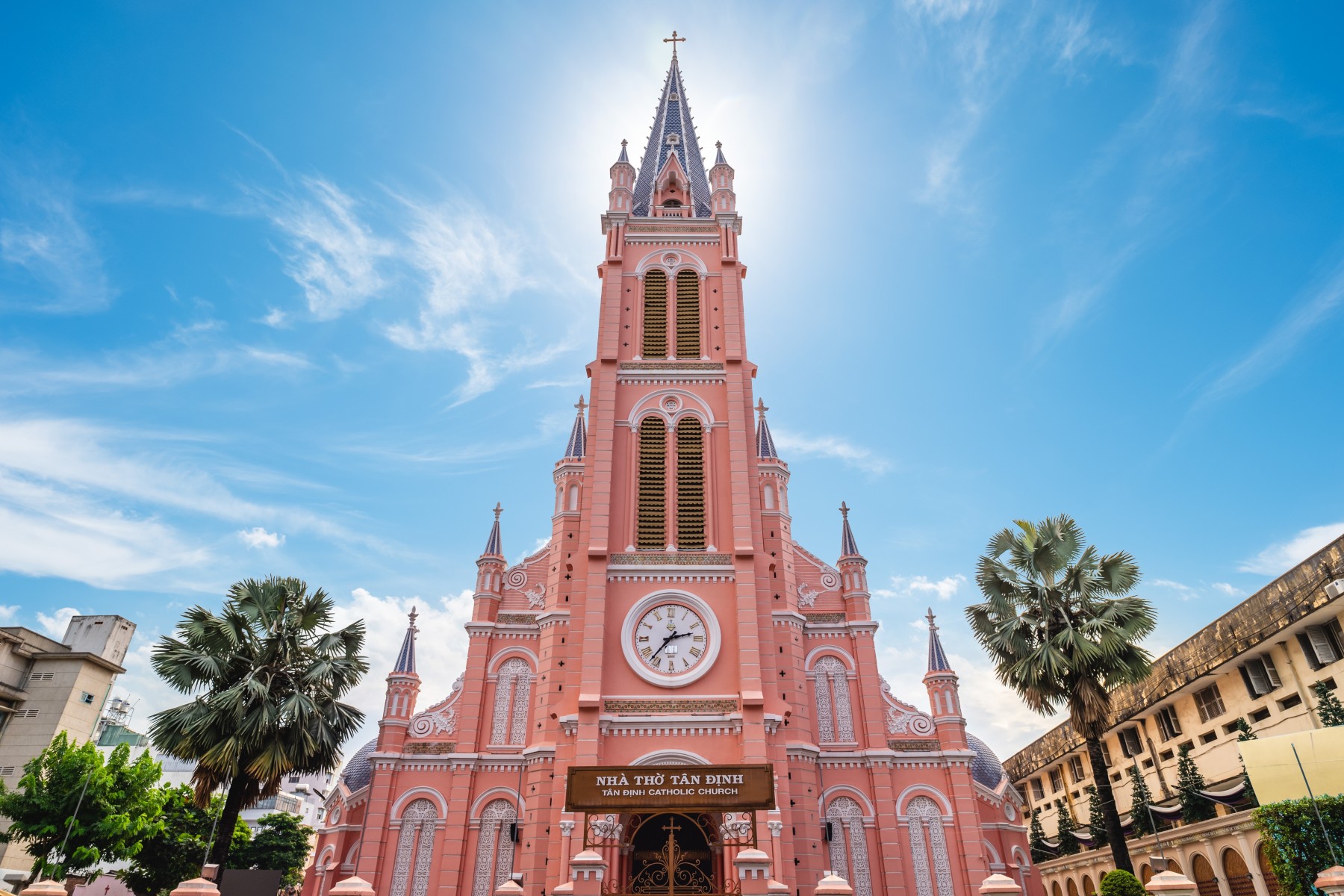
The nickname “Pink Church” comes from the distinctive colour covering the building. During renovations in 1957, the exterior was painted in a salmon-pink tone, while the interior combined pink and cream shades. This colour scheme has since become one of the church’s most recognisable features.
Its pink exterior stands out clearly against the surrounding urban landscape, making Tan Dinh Church a popular photography stop. However, it remains an active place of worship, so sightseeing and photography should be carried out without disturbing religious services or parish activities.
What is the history of Tan Dinh Church?
The history of Tan Dinh Church is closely connected with the development of the Catholic community in the area during the 19th century. According to information from Tan Dinh Parish, Father Donatien Éveillard supervised the construction of the first church. The building was inaugurated in December 1876 at a cost of approximately 15,000 piastres.
By the end of the 19th century, the original church was no longer sufficient for the needs of the congregation and was rebuilt between 1896 and 1898. Further extensions and architectural changes followed over the succeeding decades. In particular, work carried out between 1928 and 1929 added the front bell tower, entrance hall and several rear sections to provide additional space.
In 1949, the columns in the central nave were reinforced. The church underwent another renovation in 1957, when it was painted in the distinctive pink tones that remain closely associated with Tan Dinh Church today.
What stands out about the architecture of Tan Dinh Church?
According to architectural information from Tan Dinh Parish, the church is designed primarily in a Romanesque style with Gothic and Renaissance elements. Rather than belonging entirely to one architectural movement, the building combines several different stylistic features.
The façade and bell tower
The pink façade is the most immediately recognisable part of the church when viewed from Hai Ba Trung Street. White decorative details contrast with the pink exterior and highlight the doors, arches and other architectural features.
With a height of approximately 52.62 m, the bell tower gives Tan Dinh Church its distinctive identity, standing out in the city centre and becoming one of the architectural features that many visitors notice during their visit.
Arched ceilings and the church layout
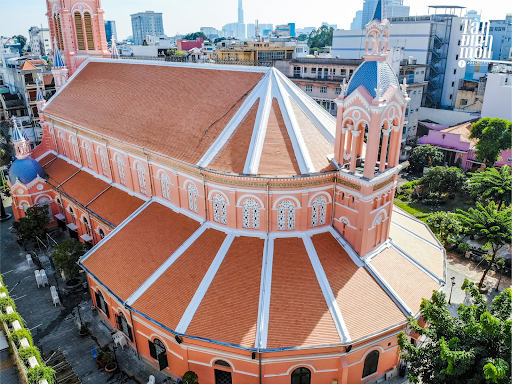
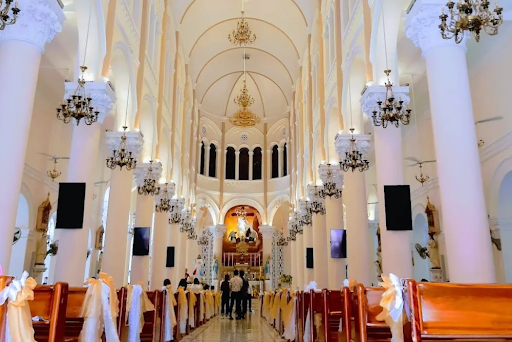
The main interior is arranged around a central nave with a high vaulted ceiling, two side aisles and outer passageways. The church also includes an upper arched gallery and chapels positioned on both sides near the entrance.
The repetition of arches and columns creates a strong sense of depth when looking from the main entrance towards the altar. It also shows that the architectural appeal of Tan Dinh Church extends well beyond the pink façade commonly seen in travel photographs.
What is worth seeing inside Tan Dinh Church?
While the exterior attracts attention for its colour, the interior places greater emphasis on religious layout and details developed over different periods of the church’s history.
Along both sides of the central nave, rows of columns and arches direct the eye towards the altar. Statues of saints and the 14 Stations of the Cross are arranged along the pillars beside the outer aisles, with some elements dating back to the late 19th century.
Another notable area is the altar. During the reconstruction of 1928–1929, parishioner François Haasz and his wife, Anne Tong Thi Muc, funded Italian marble decoration for the main altar and side altars. These elements remain important features of the church interior today.
When visiting the interior, it is worth taking time to appreciate the overall space rather than focusing only on photography. The arches, columns, altars and arrangement of the functional areas provide a clearer sense of how the church developed over more than a century.
Tips for Visiting Tan Dinh Church
What time does Tan Dinh Church open?
If the main purpose of the visit is to explore the architecture, it is best to avoid arriving immediately before or during busy Mass times. Opening arrangements may also change during Catholic holidays or special parish events.
Current Mass times at Tan Dinh Church
According to the Tan Dinh Parish website, the regular Mass schedule is currently published as follows:
| Day | Mass times |
| Weekdays | 5:00 AM, 6:15 AM, 5:30 PM, 7:00 PM |
| Sundays | 5:00 AM, 6:15 AM, 7:30 AM, 9:00 AM, 4:00 PM, 5:30 PM, 7:00 PM |
This schedule is displayed on the official parish website in 2026. During special occasions such as Holy Week, the parish feast day or other religious ceremonies, Mass times may be adjusted. Visitors should therefore check the latest parish announcements before going.
Is there an entrance fee to visit Tan Dinh Church?
Tan Dinh Church is not operated as a ticketed tourist attraction. Visitors can enter the church grounds without purchasing a ticket, but should follow on-site guidance and respect areas reserved for religious activities.
What is the best time to visit Tan Dinh Church?
Daytime is suitable for seeing the colour of the façade and architectural details clearly. For exterior photography, softer light in the morning or late afternoon can be preferable, while busy Mass times are best avoided.
Visitors hoping to see the interior should check the church’s activities before entering the sanctuary. The interior may not always be available for sightseeing or photography.
What should visitors know about taking photos?
Appropriate clothing is recommended when visiting a religious site. Inside the church, visitors should remain quiet, keep phone volume low, limit the use of equipment that creates noise or strong light, and avoid blocking walkways.
If a Mass, wedding or another religious ceremony is taking place, parish activities should take priority over sightseeing. Visitors should also follow any on-site signs indicating where access or photography is permitted.
What attractions can be combined with a visit to Tan Dinh Church?
One of the advantages of Tan Dinh Church is its location close to several central Ho Chi Minh City attractions, making it easy to include in a short itinerary rather than visiting the church as a standalone stop.
Tan Dinh Market is the nearest option. After visiting the church, travellers can continue to the traditional market, observe everyday trading activities and gain another perspective on local life.
From there, Le Van Tam Park provides a convenient place for a short break before continuing towards the city centre. Slightly farther away is Turtle Lake, surrounded by cafés and casual dining spots.
With more time, the itinerary can continue to the War Remnants Museum, Independence Palace, Notre-Dame Cathedral Basilica of Saigon and Saigon Central Post Office.
Suggested Half-Day Itinerary from Novotel Saigon Centre
Located along the same Hai Ba Trung Street, Novotel Saigon Centre provides a convenient starting point for visiting Tan Dinh Church and nearby heritage attractions as part of a seamless city exploration route.
In the morning, travellers can leave the hotel for Tan Dinh Church to view the façade, learn about its architecture and see the interior if access is available. From there, continue to Tan Dinh Market to experience the atmosphere of a local market and explore the surrounding streets.
The route can then continue towards Turtle Lake or the War Remnants Museum before returning to the hotel area around midday. For those who prefer to dine at the hotel, Food Exchange Restaurant is a convenient option within Novotel Saigon Centre.
Later in the day, OnTop Bar on the 20th floor offers a different perspective of the city from above. It can provide a relaxed ending after a day spent exploring central neighbourhoods and architectural landmarks.
Frequently Asked Questions About Tan Dinh Church
What is the official name of Tan Dinh Church?
The parish website uses the name Tan Dinh Church – Sacred Heart of Jesus, with the Sacred Heart of Jesus also serving as the patron of the parish.
Is there an entrance fee for Tan Dinh Church?
The church does not charge an admission fee like a commercial tourist attraction. Visitors can stop by, but should follow the regulations and guidance provided on site.
Can visitors enter Tan Dinh Church?
Access to the interior depends on the church’s activities at the time of the visit. If a Mass or religious ceremony is taking place, sightseeing and photography should be kept to a minimum.
Is photography allowed at Tan Dinh Church?
Visitors commonly photograph the church façade from outside. For interior photography, follow the on-site signs and avoid disturbing religious activities.
How much time should visitors spend at Tan Dinh Church?
Around 30–60 minutes is usually enough to view the façade, observe some architectural details and visit the interior when access is permitted. When combined with Tan Dinh Market and nearby attractions, travellers can allow around half a day for the full itinerary.
 Novotel Saigon Centre ☆☆☆☆
167 Hai Ba Trung, Xuan Hoa Ward, 700000 Ho Chi Minh City
Vietnam
Tel: (+84) 28 3822 4866
Email:
H7965@accor.com